Whether your ride an Aprilia, Benelli, Ducati, Suzuki, Yamaha, Honda, Kawasaki,
KTM, Triumph or MV Agusta bike you should know that our frame sliders and
other
sportbike protection accessories
are meticulously designed and manufactured to
provide the optimal
balance of extra protection for your motorcycle's frame and bodywork
while not transmitting excessive forces to your frame or engine
mounts.
The choice of
frame slider material was chosen to best withstand impact, abrasion and to
scrub off
speed
in the event of a lowside.
Our frame slider designs allows impact forces to be transmitted to the stronger
area of the frame instead of the vulnerable bodywork. Other frame slider
manufacturers may use fittings or brackets that are cast from aluminum or
recycled aluminum
scraps that have a looser and therefore weaker grain structure or cast or
stainless steel which is too strong and will cause all forces to be transferred
to the frame. All our frame slider brackets and fittings are machined from
high grade billet
aluminum.
This is considerably stronger than those made from 'cast' aluminum
or aluminum scrap and not too strong as to damage the frame during impact.
All our frame sliders and other sportbike
protection accessories feature machined aluminum inserts
which ensure the strongest possible
contact
between the frame slider, bolt
and frame of your motorcycle. Additionally all our frame sliders come
with high quality
components like replacement galvanized 12.9 grade hardened steel socket
head cap screws, 304 grade stainless steel washers and aircraft
grade lock
nuts(where applicable).
All these features you are not going to find on products from other cheaper brands.
Our components were carefully chosen
so as to construct a system consisting of a series of staged
sacrificial items
during the event of a lowside or slide. No system is
fool proof but a lot of work and thought had gone into our
designs to try and provide our customers the best value
for their money.
Fasteners
We use mostly 12.9 grade (176,000 psi tensile strength) hardened steel socket
head cap screws for our slider to frame attachments. Most socket head cap
screws of this type are supplied for use as flywheel or connecting rod
bolts. Our choice of bolts for this mounting configuration is so
that they will bend instead of snapping when subjected to excessive stresses.
They are almost always supplied in black finish but we take the extra step
of having them plated for better corrosion resistance. This may affect
their exact thread tolerances in some cases. Another thing we've been asked
this a lot: "Why socket heads instead of standard hex headed bolts?" The
answer is simple. A bolt fits into a hole in the slider. To tighten that
bolt you will need a hex drive or a socket drive. If you use a socket because
it's a hex head bolt, the hole in the slider needs to be bigger to accommodate
the size of the socket, requiring the slider puck to either be bigger overall,
or thinner walled. Hex drives are smaller profiled and therefore need a
much smaller hole in the slider for the drive to be inserted. Socket head
bolts are actually much harder to come by, especially in metric and non-standard
pitch configurations. They are considerably more expensive, but we feel
that they are a worthwhile expense. We do not use hex head screws, only
socket heads and they are all either electroplated or stainless steel.
Never black oxide coated because they will rust days after
you install them.
We also use stainless steel socket head cap screws for attaching sliders to
brackets (in street no cut model frame sliders kits). Usually they are of Grade
A2 (304) stainless steel with a tensile strength of about 101,000 psi. This
type of fastener was chosen as they are meant to snap off on excessive impact
before transferring that excessive force to the brackets which would amplify
the forces to the mounting points on the frame.
Washers: We only use 304 grade stainless
steel in all our slider kits to reduce metal to metal corrosion
and binding.
Brackets
All our brackets have usually undergone an extended period
of consideration and design work to determine the best possible
location for them and the best design that will do it's job
safely. Anyone
can make a bracket to offset a slider, we only do it when
it
makes
sense
and
is
safe to do so. That is why we sometimes do not offer
a 'no cut' kit that uses a bracket for some models of bikes.
Some bikes just do not alllow the safe and sensible use of
them.
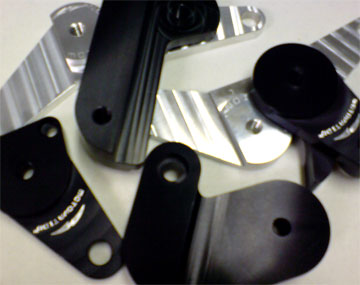
All our brackets are CNC
machined from T6 alloy. This material offers
the
optimum
weight to
strength
to elasticity
ratio
we could find in an aluminum alloy. We never use stainless
steel or steel castings or welded steel brackets as they
are much too strong. Cheap to manufacture but not ideal
for their intended use.The majority of the components on
your bike including the frame are made of aluminum. Using
a steel bracket to attach a slider to a frame will cause
too
much
of the
impact
forces
to to transferred to the frame. Especially when the bracket's
offset nature causes the forces to be amplified. All our brackets
also have built in braces in their design to prevent rotation
during impact events and to also help distribute those stresses
over a larger area of the frame.
It is easy to be seduced
by cheaper prices or or poor imitations so make sure
that you're not short changing yourself in the
long run.
Frame Slider
Material
Motovation Accessories uses a proprietary
High Molecular Density (HMD) formulation
of nylon. This nylon is impregnated during the extrusion process
with UV inhibitors to resist destabilization of the molecular
matrix
and discoloration
during
prolonged UV
exposure. This formulation is also molybdenum disulfide infused
to give it the same lubricating properties as Delrin. This
formulation is 75%
more
resistant
to abrasion
than Delrin
and
exhibits a
reduced
propensity
to "chunk
off" or "break off" during
extended abrasive events and it's 'slickness' reduces it 'grabby-ness'
during slides that may cause your bike to tumble and cause more
damage.
What about Delrin or ABS? Many frame slider manufacturers
use them because it much softer, much cheaper and easier
to machine,
i.e.
the
material
flakes off readily in
a lathe and is much easier
on the tools. The reason why Delrin is easier to work with therefore
makes it a much less suitable choice than our selection for frame
slider
material. Notice in the pictures on the left that our material
shows stringy edges at the point of abrasion. Delrin does not
do this. It will chunk and break off on impact much more readily.
Furthermore, Delrin is not UV stabilized and will discolor or
turn grey in sunlight which will further downgrade it's structural
strength. If you see a set of sliders that have been on a bike
for a while and they are greying, they are most likely made of
Delrin. When
it is in that condition they will already have been destabilized
by UV and will most likely crack when subjected to impact forces.